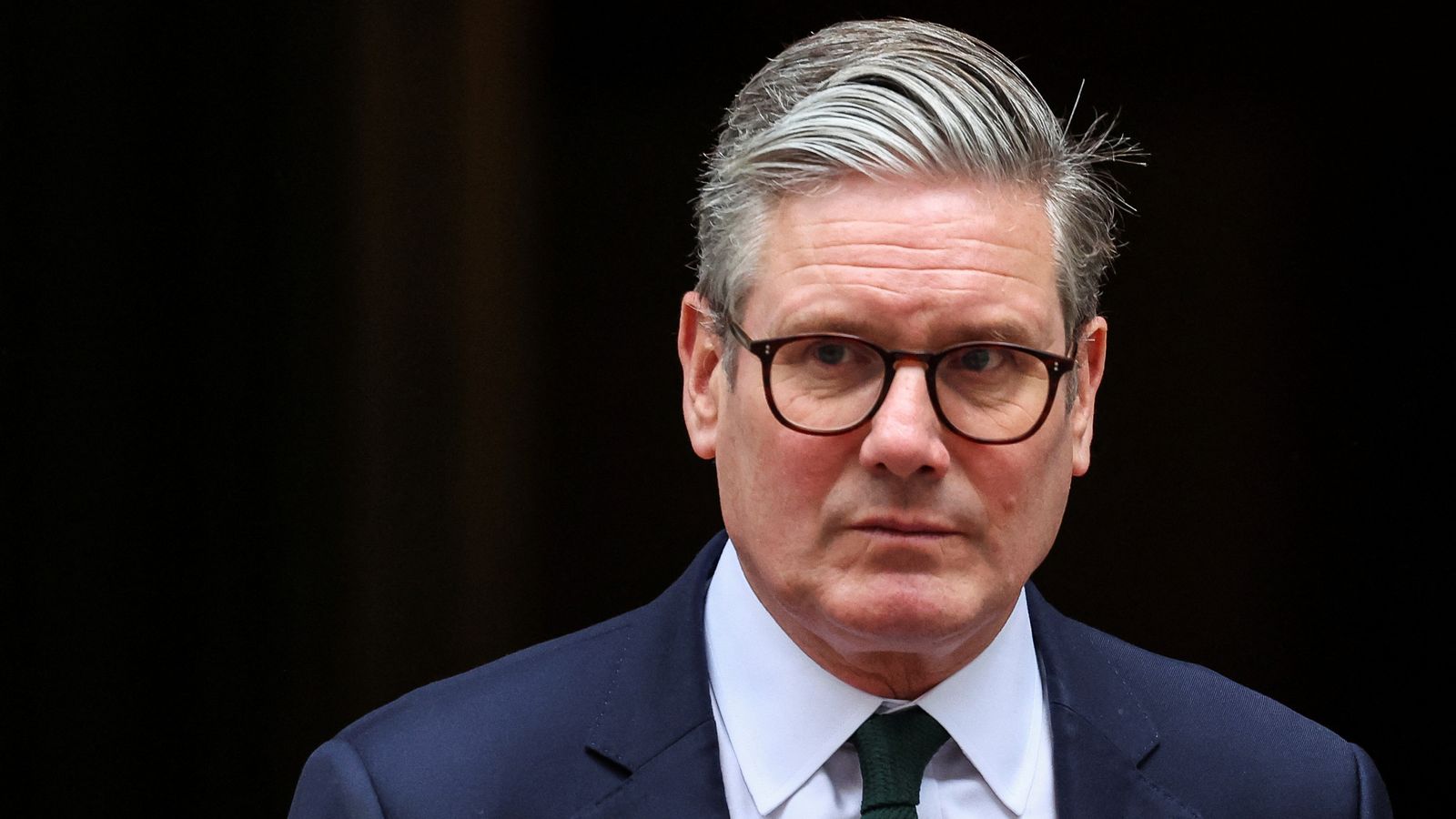
UK Prime Minister Sir Keir Starmer has defended his government’s handling of the conflict involving Iran, saying the protection of British citizens remains his “number one priority”.
His comments came after U.S. President Donald Trump criticised Starmer for refusing to allow British military bases to be used during the initial U.S.–Israel strikes on Iran last Saturday, remarking that the British leader is “no Winston Churchill”.
During Prime Minister’s Questions in the House of Commons, Conservative leader Kemi Badenoch challenged the government’s approach. She accused Starmer of expecting allies to take actions that the UK itself was unwilling to take by declining to participate in offensive operations after British bases in Bahrain and Cyprus were targeted.
However, the prime minister said the UK would not enter a war without clear legal justification and a well-defined strategy. On Sunday, Britain agreed to a U.S. request allowing American forces to use British bases, but only for defensive strikes targeting Iranian missile infrastructure.
Trump has since reacted angrily to Starmer’s earlier refusal to support the initial attacks. He described the decision as “shocking” and suggested that the relationship between the United Kingdom and the United States was “not what it was”.
Starmer rejected claims that ties between the two allies had been damaged, pointing to the use of British bases by U.S. aircraft as evidence of ongoing cooperation.
He said U.S. operations from UK facilities demonstrated “the special relationship in action” rather than “hanging on to President Trump’s latest words”.
Sir Keir said: “We’re taking action to reduce the threat with planes in the sky in the region intercepting incoming strikes, deploying more capability to Cyprus, and allowing US planes to use UK bases to take out Iran’s capability to strike.
“What I was not prepared to do on Saturday was for the UK to join a war unless I was satisfied there was a lawful basis and a viable, thought-through plan. That remains my position.”
The prime minister also noted that British military capabilities had already been reinforced in the region over recent weeks. These measures include the deployment of radar systems, ground-based air defence, counter-drone equipment and F-35 fighter jets.
He added that Wildcat helicopters equipped with anti-drone systems would arrive in Cyprus later this week. In addition, the Royal Navy warship HMS Dragon has been assigned to the region.
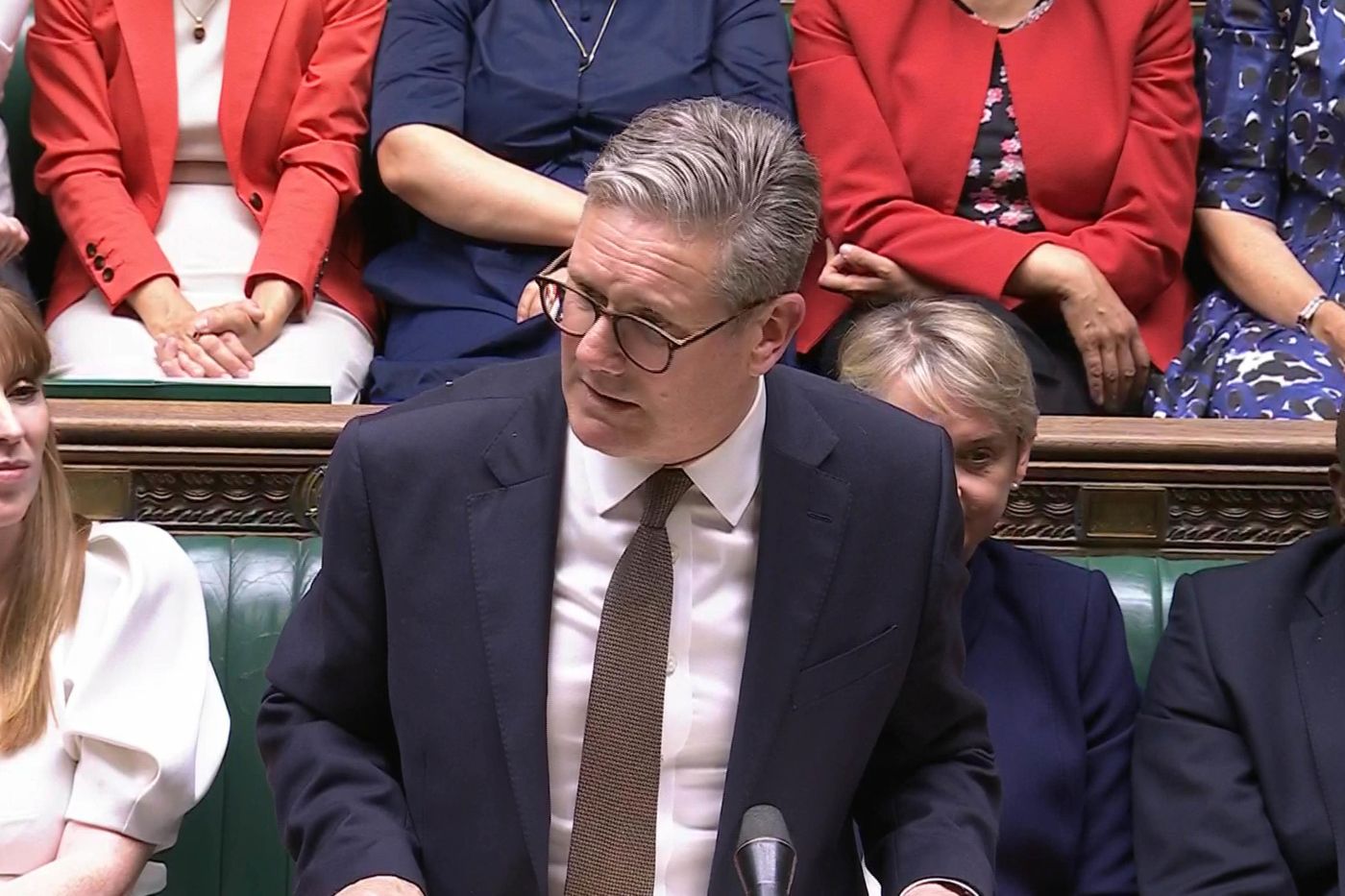
Keir Starmer in House of Commons
Badenoch criticised the government’s strategy, arguing that the UK was reacting to attacks rather than preventing them. “I would say to Labour MPs, we are in this war whether they like it or not. What is the prime minister waiting for?” she said.
She also pointed out that HMS Dragon was still docked in Portsmouth and insisted the government needed to take stronger action. The Conservative leader further accused the government of failing to invest adequately in defence.
Starmer responded by blaming the previous Conservative administration for reductions in defence spending and for leaving the armed forces under-resourced. He said recruitment targets for the army had been missed and that the military had been “hollowed out” during their time in power.
After Prime Minister’s Questions, Western officials said HMS Dragon is expected to depart from Portsmouth next week and is currently being loaded with ammunition.
Two Royal Navy Wildcat helicopters armed with Martlet missiles, designed to shoot down drones, are expected to arrive in Cyprus earlier.
A Western official also said U.S. bombers have not yet operated from the British bases at Diego Garcia or RAF Fairford, but confirmed that the UK is prepared to host them. The official indicated the aircraft could arrive within the next few days.
Earlier in the day, former Conservative foreign secretary Jeremy Hunt said he believed Starmer had made a “big misjudgement” by initially refusing to allow the United States to use British bases for offensive strikes.
Hunt said international law on the issue was unclear and could depend on whether Iran posed an imminent threat. He added that the United States plays a crucial role in Europe’s defence and argued that weakening the alliance with Washington would be a mistake.
“President Trump is not interested in that rules-based order,” Hunt said.
“He’s said so absolutely explicitly. And we have to recognise the brute strength of the American military is something we depend on now in Europe and will depend on for at least a decade.”
Retired British Army officer Gen Sir Richard Shirreff, who previously served as NATO’s deputy supreme allied commander in Europe, said the UK should focus on its own national interests.
He argued that Washington had made clear it would no longer fully guarantee European security and said Britain must prioritise protecting its overseas military bases.
“There is absolutely a case for getting involved,” Sir Richard said. “But I would not get involved in any way, shape or form in an operation where the end-stage is not clear.
“There is clearly no strategy, and yet again we have an American president who has launched a war of choice with no clear understandingof where this thing is going to end.”
Meanwhile, Middle East minister Hamish Falconer confirmed that the UK government had summoned the Iranian ambassador. The move was intended to condemn Tehran’s actions and its role “in attempting to draw the region into a wider conflict and the threat that this has presented to the hundreds of thousands of British citizens”.
The government also announced that two additional charter flights would depart from Oman in the coming days. The flights are intended to help British nationals stranded in the region following the recent escalation.
Iran has responded to U.S.–Israeli strikes by launching attacks against Israel and several U.S.-aligned countries in the Gulf, including Qatar, Bahrain, Jordan, the United Arab Emirates, Kuwait, Oman, and Saudi Arabia.
A drone struck a British military base in Cyprus during the attacks, while British personnel were also present at a base in Bahrain that was targeted by missiles.