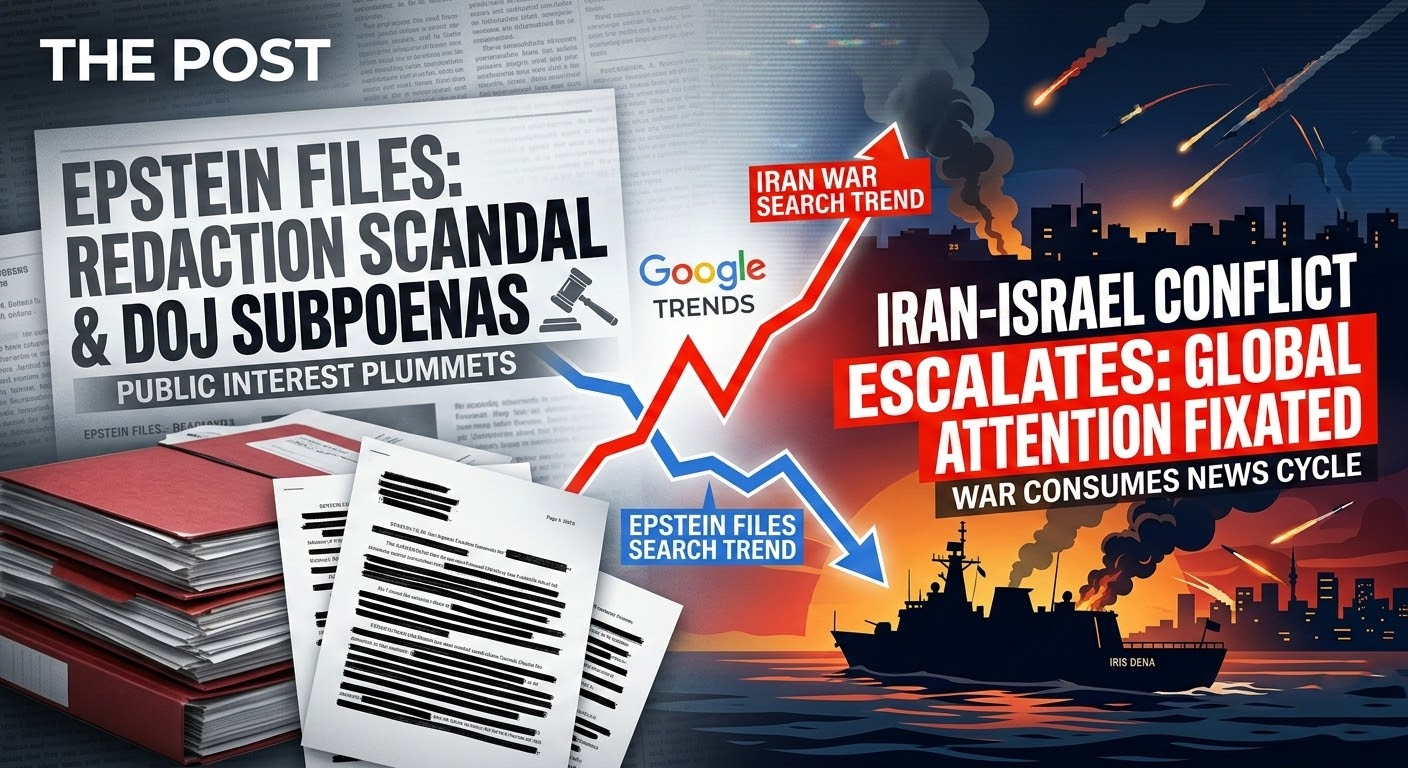
NEW YORK, March 5 (The Post) – Advocates for transparency in the Jeffrey Epstein files said they were witnessing a total collapse in public engagement because of the rapidly expanding Iran-Israel conflict as military operations entered a second week on Thursday.
Data analyzed from Google Trends reveals a stark divergence in search behavior over the last seven days. At the end of February, search volume for terms related to the Epstein document dump and the ongoing subpoenas of Department of Justice officials was at a seasonal high. However, following the launch of military operations on February 27, search interest for the Iran war spiked by over 1,200 percent while queries regarding the Epstein associates fell into a statistical dead zone.
The shift in focus is not merely a matter of public curiosity but has tangible effects on the legislative process. Just days before the military escalation, the House Oversight Committee was gaining rare bipartisan support for a deeper probe into the Department of Justice redaction process. Those headlines have now been replaced by updates on naval movements in the Indian Ocean and the sinking of the IRIS Dena.
Oversight advocates who have spent years pushing for transparency regarding the late financier’s high profile connections suggest the timing has effectively buried the most anticipated legal disclosures in American history.
The oxygen in the room has been entirely consumed by the threat of a regional war, said a senior analyst at the Transparency Oversight Group. When the public is focused on the potential for a third world war, the nuances of redacted court documents in a closed sex trafficking case naturally lose their momentum. It is a textbook example of a geopolitical crisis eclipsing a domestic scandal.
The legal pretext for secrecy is also shifting. Under a wartime footing, the administration has broader authority to invoke national security privileges. Legal experts suggest that any Epstein files containing references to foreign intelligence or international financial networks could now be permanently suppressed under the guise of protecting state secrets during an active conflict.
For now, the digital footprint is clear. The global narrative has pivoted from the pursuit of domestic justice to the management of international chaos. Whether the Epstein files will ever regain their place in the sun remains to be seen, as the world watches the horizon for the next strike in a rapidly expanding war.
“The internet is calling this war ‘EpsteinWar’ and labeling Operation Epic Fury as ‘Operation Epic Distraction.’ And we are with them.”